Skip to content
Valencia Baryton Project
Book the trio

Ensemble

A string trio with four instruments.

A string trio with four instruments? A harpsichord hiding behind the cello? The Valencia Baryton Project has dedicated itself to the performance of music written for an ancient and little-known instrument, the baryton. A cross between the viol da gamba and lirone, with six bowed strings and ten resonating and plucked strings running down the back of the neck, the baryton gives the traditional string trio an entirely new dimension.

The Valencia Baryton Project is a collective founded by Valencia-based barytonist Matthew Baker with the vision of performing the 175 works written by Franz Joseph Haydn for the instrument, as well as compositions by other composers, both modern and classical. At the heart of the ensemble is the traditional formation in trio — baryton, viola, and violoncello — for which Haydn wrote 123 works of outstanding beauty during his time as court composer for Prince Esterházy of Austria.

With Matthew Baker, one of only a handful of baryton performers in the world, the Valencia Baryton Project have delighted audiences in over 100 concerts throughout North, Central and South America as well as Europe with what is considered to have been the pinnacle of aristocratic instruments of the classical era. Their work has been described as "beautifully polished" (Musicalifeiten) and "delightfully inventive" (The Strad). They have been featured in publications and programs such as Berklee Now (USA), Radio Nacional de España, BBC 3 (UK), Die Welt (Germany), and Classic FM (UK) amongst others. The Valencia Baryton Project's barytonist — Matthew Baker — was also featured in The Strad in March of 2023 in a full-length article about the instrument.

In 2021, the Valencia Baryton Project released Naxos Records' first ever baryton CD, beginning a series that continued in 2023 and again in March 2026 with the third volume — the first recording featuring the ensemble's current trio. Reviewing it for The Strad, David Threasher called the result "intriguing — and oddly addictive." Their recordings have been described as "spiritedly performed and superbly recorded" (Classical Music Daily, UK), "highly recommended" (Stretto, Belgium), "a discovery for curious ears" (OnlineMerker, Switzerland), and "virtuosic" (WDR 3, Germany). The first CD was nominated as a finalist for Best Classical CD of the Carles Santos Premios and has appeared in Gramophone's top 20 Classical charts in the UK and AllMusic's Top Classical CDs of 2021.

As Haydn was not limited to writing trios, likewise the Valencia Baryton Project has from the beginning been a flexible ensemble, adapting from its standard trio setting to accommodate anything from duo to quintet or even octet — performing his quintet this season, with the octet in planning — to take in the numerous works written for the instrument.

Beyond their work with Haydn and his contemporaries such as Lidl, Tomasini and Burgksteiner, the Valencia Baryton Project is committed to the creation of new works for this forgotten instrument, and has worked with Canadian composer Steve Zink, British composers Ivan Moody and John Pickup, Spanish composer José Zárate and Argentinian composer Julián Calarco to expand the repertoire and bring this soundscape into modern composition. They have also collaborated with international artists such as Carrie Krause (violin, USA), Jeremy Brooker (baryton, UK), Chris Hirst (theorbo, UK) and Paloma Friedhoff (soprano, Spain) amongst many others.

The baryton

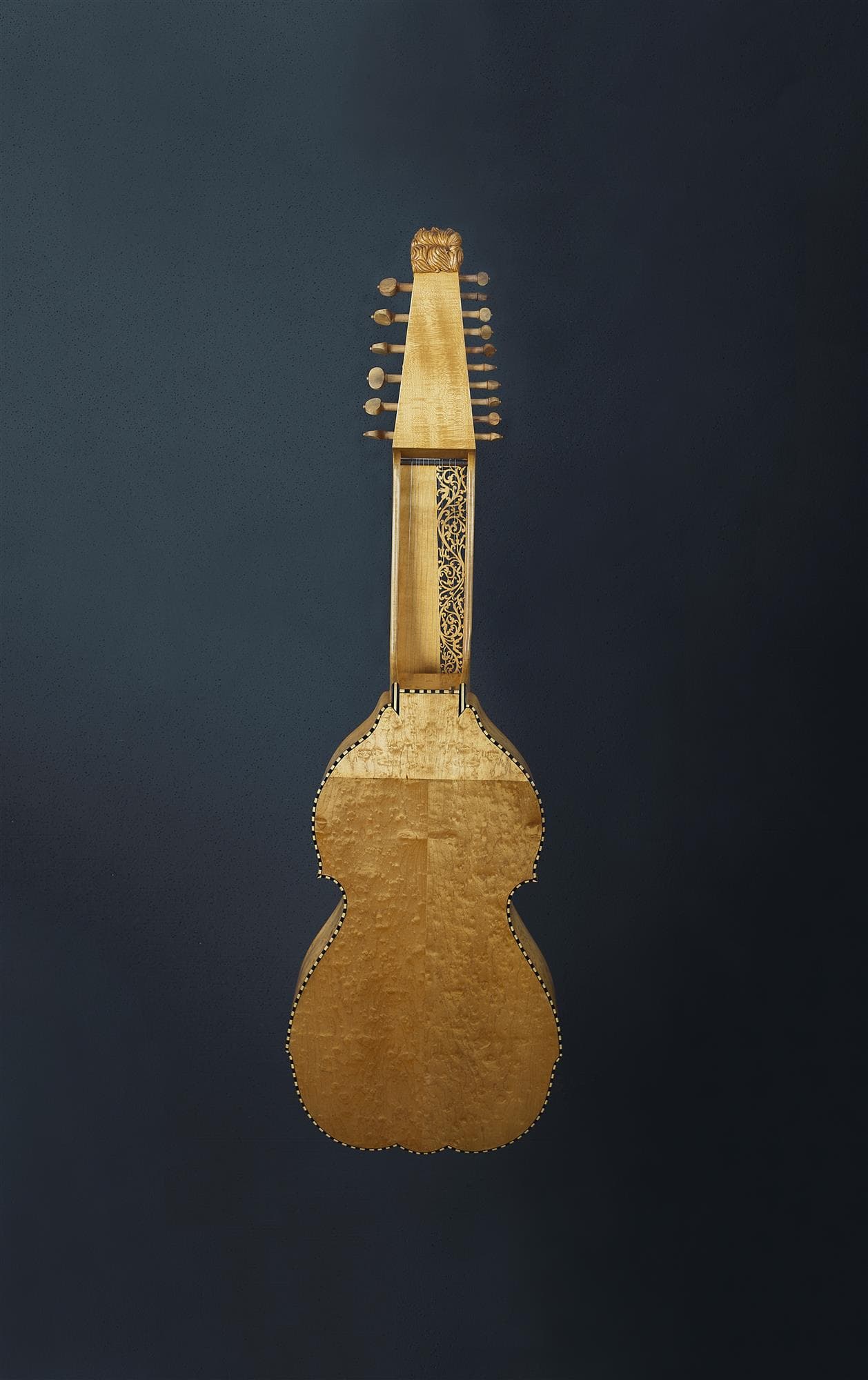
The back of the baryton's neck, showing all ten sympathetic strings and their tuning pegs.

For about a decade in the 1760s and 1770s, Haydn wrote constantly for an instrument that has almost completely disappeared from the concert stage. His patron, Prince Nikolaus Esterházy, played the baryton, and Haydn wrote 175 works for it, including 126 trios. That is more individual works than he wrote for symphony orchestra, yet most of this music is almost never performed.

The baryton itself helps explain why so much music was written for it. It has six bowed strings over a fretted fingerboard, with ten metal strings running behind the neck. Those metal strings vibrate sympathetically, adding resonance, but the player can also pluck them with the left thumb while continuing to bow the main strings. One player is therefore producing two different layers at the same time: a bowed line and a plucked accompaniment. The instrument sits somewhere between the viola da gamba and the lirone.

Haydn was not the only composer writing for it. Other musicians at the Esterházy court, including Andreas Lidl, Luigi Tomasini, and Joseph Burgksteiner, also contributed to the repertoire. By around 1800, though, the baryton had largely disappeared, taking most of that music with it.

The instrument is no longer limited to its eighteenth-century repertoire. Twelve new works have been written for the baryton at the commission of the Valencia Baryton Project. So the baryton is not simply being revived as a historical instrument. It is being written for again.

The trio

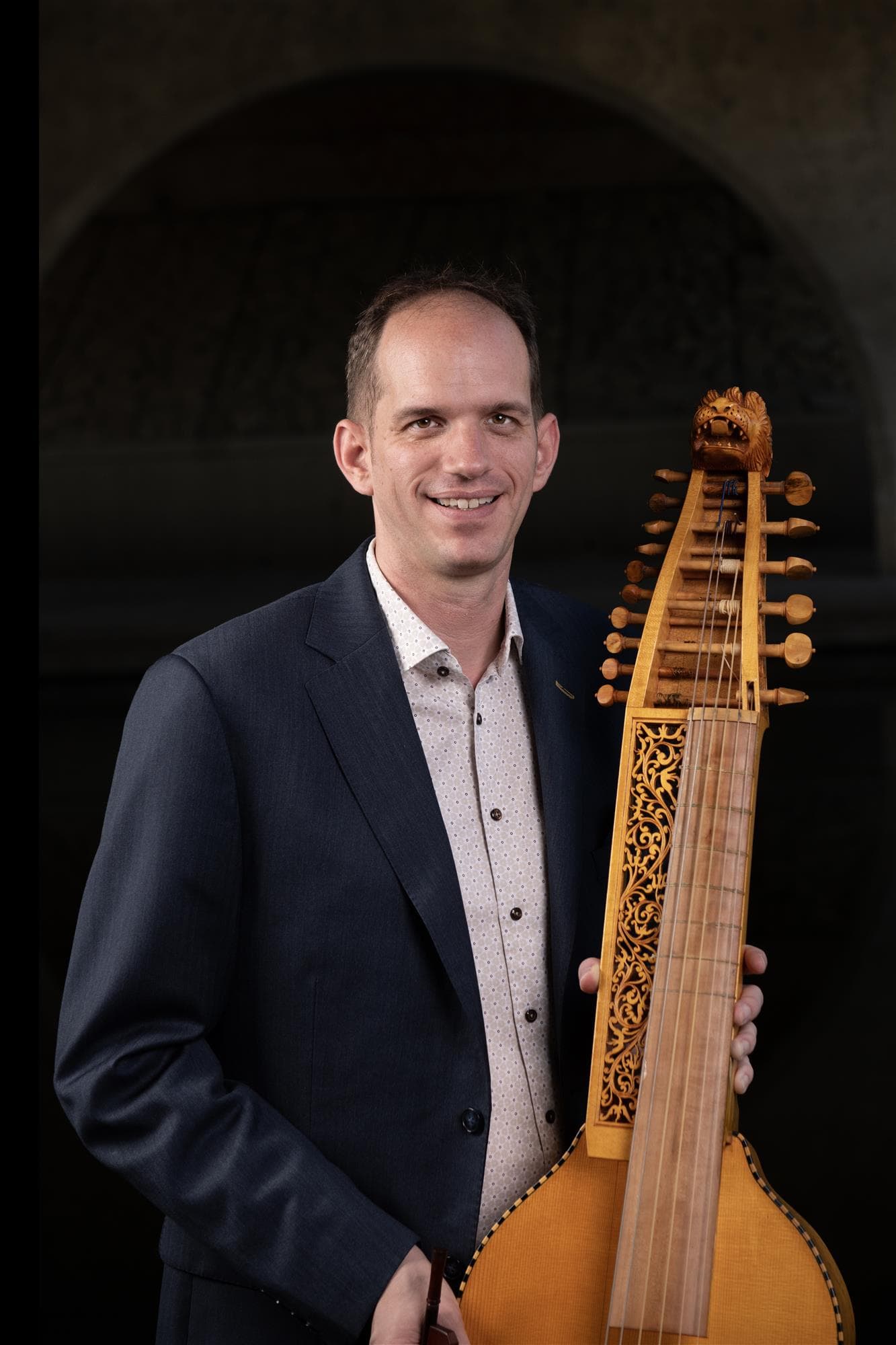
Matthew Baker holding the baryton, its carved lion's-head scroll and two ranks of pegs beside him.

Baryton

Matthew Baker

Originally from Sioux City, Iowa, Matthew Baker began his professional music career as a double bassist at the early age of 13 with the Sioux City Symphony Orchestra, first as section and later as principal double bass.

Matt leads a diversified performance career, having achieved recognition worldwide for his work in classical, jazz, folk, and theatrical performance in over 20 countries on both the baryton and double bass. He has had critical acclaim from concerts and recordings in publications such as The Strad, Gramophone, The Times, Independent, and Bass World, among many others.

Matt has lived in Valencia, Spain since 2006 working as a double bassist in the Palau de les Arts (opera of Valencia), which was founded by Lorin Maazel and Zubin Mehta as well as teaching jazz and contemporary music at Berklee College of Music Valencia.

With his string quintet, the Elan Quintet, Matt has done world premiere recordings of 7 quintets by the French Romantic Era composer, George Onslow in a cycle by Naxos Records rediscovering Onslow's beautiful quintet music with double bass. He also performs on the rare instrument, the baryton, in his chamber trio, the Valencia Baryton Project, which has recorded 3 CDs for Naxos and having had full length articles written in both the Strad and Ritmo about his endeavors to resurrect this instrument.

As a jazz performer, Matt has shared the stage playing double bass with legends such as Bob Mintzer, Victor Wooten, Clark Terry, and many others. In 2019, Matt performed the world's first concert of jazz baryton and has since then pushed the boundaries of the instrument to work on experimental electronic music with French pianist and composer, Baptiste Bailly and Italian electronic music artist, IMGL.

In other styles, Matt has been credited as one of the pioneers of Celtic Jazz in the late 90s with Catriona McKay, has toured the world with the theatrical string septet, Gogmagogs, and currently performs tango with the last living member of Astor Piazzolla's legendary sextet, Daniel Binelli.

Matt is an ambassador to Schertler Electronics and is an endorser for Wiedoeft Rosin.
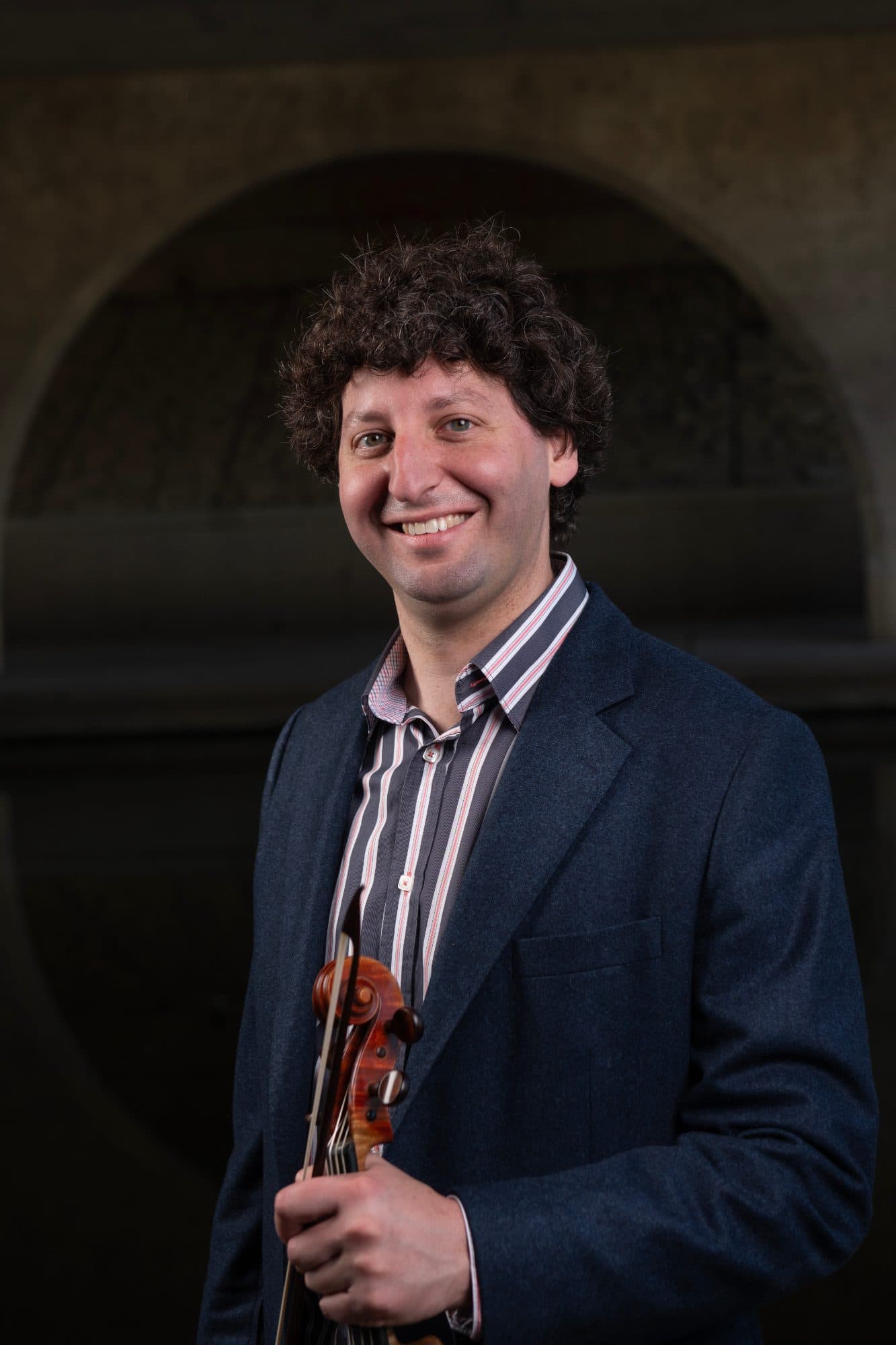
Brett Walfish, violist and Co-Founder and former Executive Director of the Rushmore Music Festival, has performed as a soloist and chamber musician throughout the United States, Ireland, Italy, and Israel. His concerts have taken him to Tel Aviv Opera House, the National Music Museum, the Historic Blackfriars Theatre and Carnegie Hall, among others. Praised by the conductor David Effron for a warm sound full of a “myriad of colors,” Brett is an expressive and charismatic performer. He has collaborated with world-renowned artists including Philip Setzer, Atar Arad, Shmuel Ashkenasi, Stephan Barratt-Due, Annie Fullard, Michael Klotz, Rudolf Koelman, Misha Vitenson, and Hillel Zori. He has also performed with the highly acclaimed conductorless chamber orchestra, A Far Cry, as well as the New World Symphony.

Dr. Walfish is a devoted teacher of violin, viola, and chamber music, and has studied string pedagogy with the legendary Mimi Zweig at the Indiana University and completed a two-year long-term Suzuki teacher training certification at the School for Strings in New York City. He frequently travels across the United States for guest masterclasses and teaches privately through the Professional Violin Studio in Rapid City and Spearfish. His primary mentors included Lawrence Dutton of the Emerson String Quartet, Nicholas Cords of the Brooklyn Rider Quartet, and Martha Katz and Atar Arad of the Cleveland Quartet. Dr. Walfish holds a Master of Music degree and a Graduate Diploma in Viola Performance from the New England Conservatory, as well as a Bachelor of Music degree from Indiana University Jacob's School of Music.

His students have been accepted to the Juilliard School, New England Conservatory, Manhattan School of Music, Harvard University, Cornell University, among others.

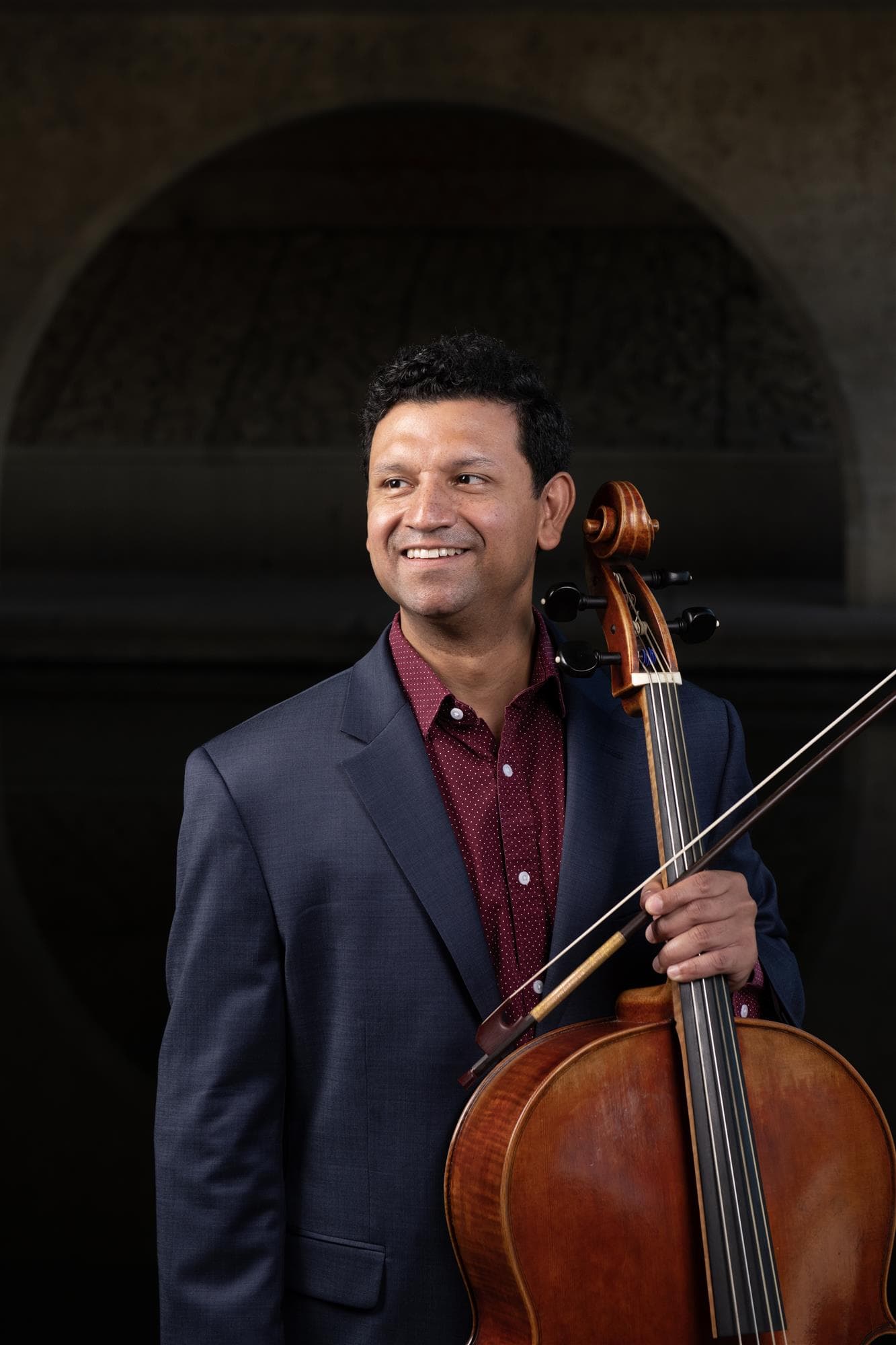
Ismar Gomes with his cello and bow.

Violoncello

Ismar Gomes

Dr. Ismar Gomes is a chamber musician, recitalist, baroque cellist, and orchestral player. Recent performance highlights include recitals as a member of Duo Sorolla on distinguished concert series across the United States, as well as collaborations with members of the Pittsburgh Symphony, Saint Paul Chamber Orchestra, the Emerson, and the Johannes Quartets. A former member of the Virginia and Richmond Symphonies, he frequently performs with the Baltimore Symphony. As a baroque cellist, Dr. Gomes is a member of Mélomanie and is a regular guest with several early music ensembles. Recently having joined the Valencia Baryton Project, Dr. Gomes will embark on several national tours over the coming seasons and continue recording the Haydn Baryton Trios for Naxos.

Dr. Gomes has worked with many important composers including George Walker, Aaron Jay Kernis, Marc Neikrug, James Lee III, and David Lang and has additionally commissioned and championed works by many of today's leading and emerging composers. As a recording artist Dr. Gomes has recorded with the Harlem Quartet and recently released two albums with Mélomanie, apart from other efforts showcasing the works of Larry Nelson, Mark Hagerty, and others.

Formerly Visiting Assistant Professor of Cello at Luther College, he currently serves on the Cello and Chamber Music Faculty at George Mason University and Gettysburg College, and has presented masterclasses at many institutions including Shenandoah Conservatory, Georgetown, Towson, and Duke Universities. Past faculty appointments include the Cleveland Institute of Music Summer Chamber Music Festival, StringFest at Merkin Hall, the Performing Arts Institute, CelloSpeak, and the Three Bridges Festival.

Dr. Gomes serves on the cello faculty of the Rushmore Music Festival where he is also a member of the Board. Ismar attended the Peabody Conservatory, studying with Alison Wells and Amit Peled. Previous teachers include Marc Johnson and Clive Greensmith of the Vermeer and Tokyo Quartets. He earned his Doctor of Musical Arts Degree from Stony Brook University, under the tutelage of Colin Carr.

With

  • Estevan de Almeida Reis viola
  • Alex Friedhoff violoncello
  • Benjamin Birtle violoncello
  • Carrie Krause violin
  • Jeremy Brooker baryton
  • Chris Hirst theorbo
  • Paloma Friedhoff soprano

Inquire about dates